

Advanced in Some Areas, Behind in Others: Making Sense of Uneven Development in Preschoolers
Your four-year-old knows every planet in order and reads words right off street signs. She also can't climb the stairs without help, resists using the toilet, and falls apart when her routine changes. That mix is confusing, and it can leave you unsure whether something's wrong or whether you're worrying too much. You're not imagining things, and it's fair to want answers.
Children don't develop on a single track. It's common for a preschooler to be well ahead in one area and behind in another, and that gap can be hard to read when you're the one living with it. What sits behind it is worth understanding, because that's what separates a normal spread of skills from a pattern that deserves a closer look.
What Does “Uneven Development” Mean?
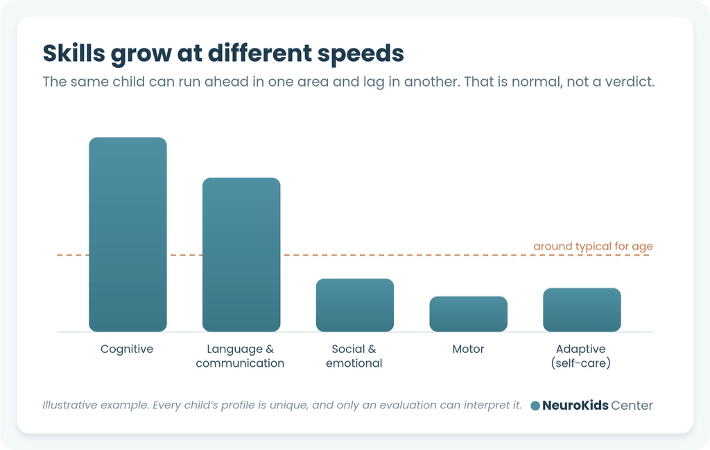
Development isn't one thing. It's a handful of separate areas, and each one moves at its own pace:
● Cognitive skills: thinking, learning, memory, problem-solving, and early academic knowledge like letters, numbers, and facts.
● Language and communication: understanding words, speaking, and using language to connect with others.
● Motor skills: large movements such as running and climbing (gross motor), and small ones such as holding a crayon or using a fork (fine motor).
● Social and emotional skills: playing alongside others, managing feelings, and handling changes in routine.
● Adaptive skills: the everyday self-care of dressing, feeding, toileting, and following daily routines.
A child rarely sits at the same level across all five, and some unevenness is completely typical. What matters is the size of the gap and whether the lagging areas are getting in the way of daily life at home or at preschool.
Why A Strength In One Area Can Hide A Delay In Another
A striking ability can quietly pull attention away from a lagging one. When a three-year-old rattles off facts about trains or reads words far beyond his age, the adults around him often assume the rest of his development has kept pace. Relatives wave off concerns. A preschool teacher managing a full classroom may not catch that the same child cannot work a zipper or join a group game.
The pattern shows up in ordinary ways, including a child who counts to a hundred but cannot tell a classmate he is upset, or a preschooler who names every color but cannot yet pull on his own coat. Psychologists sometimes call an isolated, advanced ability a splinter skill, meaning one that stands apart from a child’s broader profile rather than representing it.
Early academic knowledge is especially easy to see and praise, which can make it seem like a bigger signal than it is. A child who has memorized the alphabet is showing you one specific strength. That strength says nothing about how he is doing with coordination, emotional regulation, or self-care.
A Capable Child Can Still Need Everyday Help
What a child knows and what a child can do on their own are two different things, and that's where a lot of the confusion comes from.
Cognitive ability is the thinking part: reasoning, learning, remembering. Adaptive skills are the doing part, the practical stuff a child uses to get through an ordinary day, like handling everyday concepts, getting along with other kids, and managing self-care such as dressing and toileting. The two don't run on the same clock.
That's why a bright preschooler can still struggle with dressing, toileting, or transitions. The knowing is there. The doing is still catching up. A child who reads his letters but can't work his shoes isn't a puzzle to solve; he's just showing you two separate skills at two different stages.
An Uneven Profile Is Not A Diagnosis
None of this means an uneven profile points to a specific condition. Many children with scattered skills are simply moving at their own individual pace and will even out with time. An uneven profile can be linked to a wide range of possibilities, from ordinary variation to a learning difference, a developmental delay, or a condition such as autism or ADHD. The pattern on its own does not tell you which, if any, applies.
One skill, high or low, is never enough to draw a conclusion from. Only a careful look at the whole child, across every domain and in the settings where he actually lives and learns, can do that. That is what a developmental assessment is for: not to pin a label on a child based on one impressive or one worrying skill, but to understand the full picture.