

Average scores on a school evaluation don’t always match what you see at home. If your child didn’t qualify for services but homework still ends in tears most nights, your pediatrician may suggest a neuropsychological evaluation. A pediatric neuropsychological evaluation takes a close look at how a child's brain works and how that shows up in learning, attention, behavior, and everyday life. School testing and neuropsychological testing share some of the same tools, but they’re designed for different jobs.
Brain-Behavior Relationships, in Everyday Terms
Neuropsychology connects how the brain works with how a person thinks, learns, and behaves. The American Psychological Association describes clinical neuropsychology as a specialty dedicated to understanding the relationships between brain and behavior. For a parent, that means looking past what a child does to the thinking skills underneath it.
Two third graders can both read slowly for completely different reasons. One has trouble linking letters to sounds, so every word takes effort to decode. The other decodes fine but loses their place, drifts off mid-paragraph, and has to start over. On a report card, the two look the same. Their brains are doing very different work, though, and the support that helps one child may do little for the other.
What the Evaluation Measures
A neuropsychological evaluation covers a wide range of thinking skills, often called cognitive domains, along with how a child is doing emotionally and socially. The National Academy of Neuropsychology describes the evaluation as measuring a person's neurocognitive, behavioral, and emotional strengths and weaknesses. In a child's evaluation, that usually includes the areas below.
● Attention: How well your child can focus, stay with a task, and filter out distractions.
● Executive functioning: Planning, organizing, getting started, shifting between tasks, and keeping track of what comes next.
● Memory: Taking in new information, holding onto it, and pulling it back up when it's needed.
● Language: Understanding what others say and putting thoughts into words.
● Visual-spatial skills: Making sense of what the eyes take in, from shapes and maps to letters on a page.
● Processing speed: How quickly your child can take in simple information and respond.
● Academic skills: Reading, writing, and math, compared with what's expected for their age and grade.
● Social-emotional functioning: Mood, worry, behavior, and how your child relates to others.
Most of these areas are measured with standardized tests. Every child gets the same tasks, given in the same way, and their results are compared with a large group of children the same age. That comparison lets a neuropsychologist say whether a skill is a relative strength, right where it should be, or an area where your child needs more support. The tests are paired with an interview about your child's development, health, and schooling, and often with questionnaires from parents and teachers.
School Testing and Neuropsychological Testing Answer Different Questions
A school evaluation decides whether a child qualifies for special education services. A neuropsychological evaluation explains why a child is struggling and what's driving it, which can include a formal diagnosis.
Schools evaluate students under the Individuals with Disabilities Education Act, known as IDEA. The school team's question is a legal one, whether a student meets criteria for one of the disability categories in federal regulations and needs specially designed instruction because of it. A neuropsychological evaluation goes after diagnosis. It sorts out which conditions are present, how they interact, and what they mean for your child at school and at home.
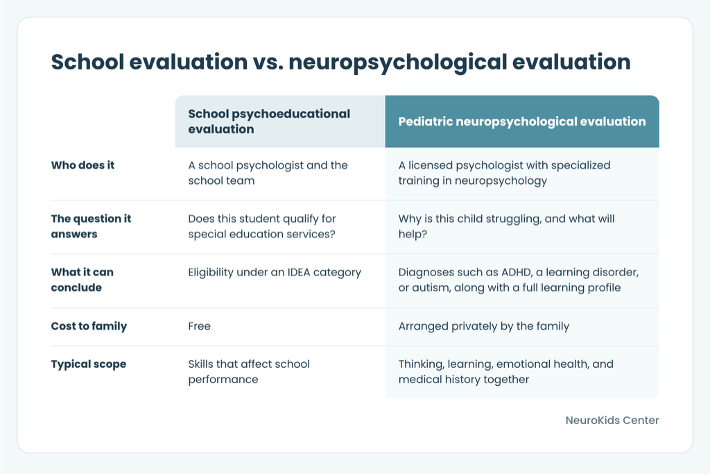
A school evaluation costs families nothing, and its findings can lead to an IEP and the services that come with it. The difference is in scope, since a school team is asked to settle eligibility and often lacks the time or the mandate to dig further. A child can also be found ineligible for special education and still have something, like ADHD or anxiety, that deserves attention.
According to the National Academy of Neuropsychology, when a family needs comprehensive information about a child’s brain-related strengths and weaknesses to understand where a learning problem comes from, a neuropsychological evaluation is most often the best choice.
When a Neuropsychological Evaluation Makes Sense
Plenty of children who struggle in school do well with school support, good teaching, and time. A neuropsychological evaluation tends to help most in situations like these.
● Problems keep going even with solid support at school and at home
● Your child has a medical or neurological history, such as seizures, a brain injury, premature birth, or a genetic condition
● More than one explanation seems possible, like ADHD, anxiety, a learning disorder, or some mix of them
● School testing found your child didn't qualify for services, yet the struggles haven't gone away
● You need a diagnosis that a school evaluation isn't designed to provide, for a pediatrician, a therapist, or an accommodations request
● Your child's profile is uneven, with real strengths in some areas and surprising gaps in others
Younger children fit this picture too, since uneven development in preschoolers often shows up well before kindergarten. For high schoolers, an evaluation is often what supports a request for SAT or ACT accommodations. Some teens who qualify still don’t want to use them, and that hesitation is worth talking through too.
How the Two Can Work Together
Families can share a private evaluation with their child's school, and the school has to take it into account. Under IDEA, a school must consider an evaluation that parents obtained privately in any decision about the child's education, as long as it meets the district's criteria. The school isn't obliged to adopt every recommendation in the report, though the findings do have to be on the table.
In Georgia, schools have 60 calendar days from parental consent to complete an initial evaluation, with exceptions for school breaks and summer. Some families pursue both at once, so the school process keeps moving while a private evaluation fills in the clinical picture. A neuropsychological report can also help an IEP or 504 team choose accommodations that match how your child learns.
What to Expect From NeuroKids Center
NeuroKids Center provides comprehensive neuropsychological evaluations for children, adolescents, and young adults in Gainesville and across North Georgia. Each evaluation is tailored to the questions your family brings, and it moves through four stages.
1. Interview and history. We talk with you about your child's development, health, school experience, and what concerns you most.
2. Testing. Your child works through standardized tasks chosen for their age and the questions at hand.
3. Feedback. We walk you through the results, what they mean, and how the pieces fit together.
4. Written report. You receive a report that lays out your child's learning profile, any diagnoses, and specific recommendations for school and home.
Schedule a Neuropsychological Evaluation in Gainesville
If you've tried tutoring, extra help at home, and a school evaluation, and your child is still struggling, a neuropsychological evaluation can help explain why. Contact NeuroKids Center with your questions, even if you aren't sure yet which kind of evaluation your child needs. You can also read more about how a neuropsychological evaluation works before you reach out.
Frequently Asked Questions
What does a pediatric neuropsychological evaluation test?
It looks at attention, executive functioning, memory, language, visual-spatial skills, processing speed, academic skills, and social-emotional functioning. The exact mix depends on your child's age and the questions being asked.
How is a neuropsychological evaluation different from school testing?
School testing determines whether a student qualifies for special education services under IDEA. A neuropsychological evaluation is broader and explains why a child is struggling, which can include diagnoses the school process isn't designed to make.
Will my child's school accept a private evaluation?
Federal law requires the school to consider a private evaluation you share, as long as it meets district criteria. The school doesn't have to adopt every recommendation, so it helps to go over the report with the IEP or 504 team.
How long does a neuropsychological evaluation take?
It varies with a child's age and the questions being asked. The testing often runs several hours, sometimes across more than one visit, with a feedback session once the report is ready. We can give you a clearer sense of timing once we understand your concerns.